Lumail vs Braze: Which Email Platform Fits How You Work?
Braze is quote-based omnichannel engagement for large brands. Lumail is self-serve email with published volume pricing and 89 MCP tools for agents.
In this guide
Braze is an enterprise customer engagement platform that orchestrates email, push, SMS, WhatsApp, and in-app messages under a sales-quoted contract; Lumail is a self-serve email platform with published prices, built so AI agents and developers can operate it. They overlap on email and little else. Braze is for brands running every channel from one customer profile. Lumail is for teams whose channel is email.
That makes the choice mostly about scope. If you need push notifications, in-app messages, and real-time cross-channel journeys for a large user base, Braze is the category, and Lumail is not trying to replace it. If you need email done well, with pricing you can read before a sales call, the comparison looks different. Braze facts here come from its official pricing page as of August 2026; plans change, so check before you buy. For the compact version, see the side-by-side comparison table.
Lumail vs Braze at a glance
| Decision | Lumail | Braze |
|---|---|---|
| Core focus | Campaigns, workflows, transactional email, and AI agents | Cross-channel engagement: email, push, SMS, WhatsApp, in-app |
| Pricing basis | Emails sent; unlimited subscribers on every plan | Edition plus monthly active users plus Action Credits |
| Free plan | 3,000 emails per month, no credit card | None; 14-day free trial, no credit card |
| Paid entry | Premium at $20/month with 40,000 emails | Not published; priced by sales |
| AI and developer access | 89 MCP tools, CLI, TypeScript SDK, REST API | BrazeAI in the dashboard, REST API, MCP in early access |
| Automation | Graph workflows on every plan | Canvas: real-time cross-channel journeys with experiments |
| Transactional email | Built in through the API or SMTP | API add-on in select packages; no SMTP relay |
| Best fit | Teams running email through agents, code, and a visual app | Large consumer brands orchestrating many channels at scale |
Lumail's current plans are on the Lumail pricing page.
Choose Lumail if AI agents should operate your email
Braze builds AI into the product: an in-dashboard assistant, custom agents that run inside journeys, and AI decisioning. Its remote MCP server is in early access, focuses on reading campaigns, segments, and analytics plus editing templates, and does not return user-level personal data or send campaigns. The REST API remains the way to send.
Lumail exposes 89 organization-scoped MCP tools covering campaigns, subscribers, tags, segments, workflows, templates, analytics, and transactional sending. The same operations run in ChatGPT, Claude, Claude Code, and Cursor, and through a CLI, a TypeScript SDK, and a REST API. An agent works on your real audience and real workflow state.
In practice you can ask an assistant to:
- draft next week's campaign from an approved brief and template;
- build or edit a workflow graph, not only read a report;
- tag and segment subscribers before a targeted send;
- send a receipt or password reset from the same account;
- summarize last month's results without exporting a CSV.
You keep consequential actions behind human approval and finish drafts in the visual editor.
Choose Lumail if email is your channel, you want a price you can see before signing, or you want agents to operate the account rather than read from it.
Choose Braze if you orchestrate many channels at scale
Braze is built for consumer brands with large, active user bases, and its depth shows. It can coordinate email with push, SMS, WhatsApp, in-app messages, and content cards from a single customer profile, reacting in real time.
Choose Braze if:
- you need email together with push, SMS, WhatsApp, and in-app messages in one journey;
- you need real-time journeys at large scale, with enterprise SSO, dedicated IPs, and sales-led onboarding;
- you want AI agents working inside journeys and catalogs, not only beside them.
Lumail does not try to be an omnichannel platform. It has no push, SMS, or in-app messaging and no mobile SDKs. Its focus is the email system: audiences, campaigns, graph workflows, transactional delivery, and the programmable surface around them.
Compare the pricing models, not the starting prices
Braze does not publish a rate card. Pricing combines three parts: a platform edition (Go, Select, Pro, or Enterprise), monthly active users, meaning customers who actually interact rather than every stored profile, and Action Credits spent across email, SMS, in-product messages, and AI agents. There are no per-seat fees. To get a number, you talk to sales.
The only public Braze price is an AWS Marketplace listing: $75,000 for 12 months, covering 100,000 monthly active users, 5 million emails, two dedicated IPs, and 750,000 US text messages. It is not mapped to a named edition.
Lumail prices by emails sent, with unlimited subscriber storage on every plan:
- Free: 3,000 emails per month, no credit card;
- Premium: $20/month with 40,000 emails included, then $0.60 per 1,000;
- Business: $200/month with 400,000 emails included, then $0.40 per 1,000.
A worked example
Say you send 400,000 emails a month, or 4.8 million a year, just under the 5 million in that marketplace listing.
On Lumail, that is Business: $200/month with 400,000 emails included, so $2,400 for the year.
On Braze, the marketplace bundle is $75,000 for the year. That price also covers 100,000 active users, dedicated IPs, and SMS, so it is not a like-for-like email price. It does show the scale Braze is priced for.
If you need those other channels, the comparison is Braze against other engagement platforms, not against Lumail. If you only need email, you would be paying for a much larger product.
Compare automation and transactional email
Braze's journey builder, Canvas, is its core. Journeys can start on a schedule, on a user action, or from an API call, then branch by action or audience, split for experiments, and hand steps to AI agents. Frequency caps and quiet hours apply across channels.
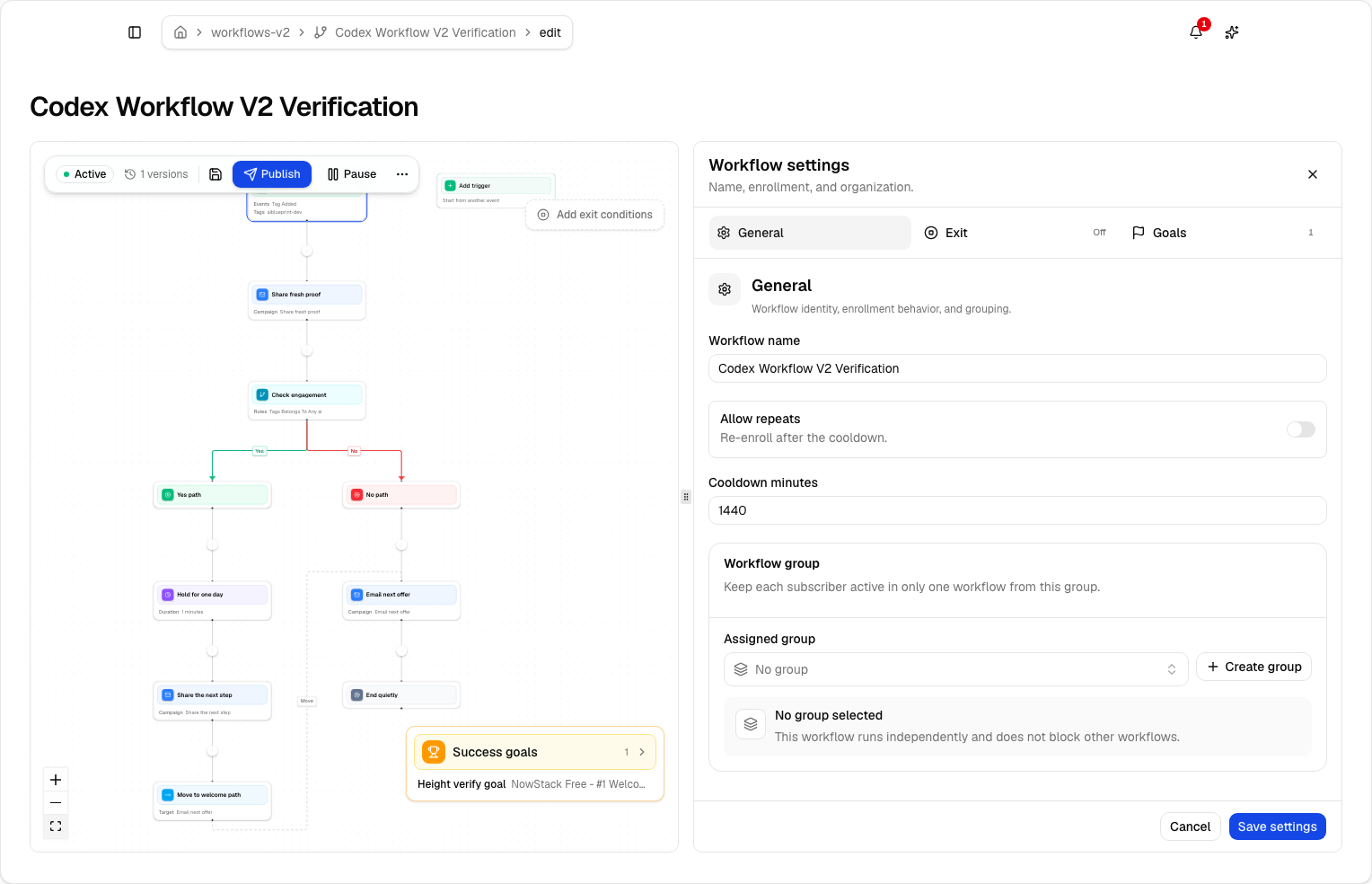
Lumail's workflow engine is graph-based and included on every plan, including Free. It supports subscriber, tag, event, schedule, and manual triggers; email, wait, action, and webhook steps; condition and weighted branches; and goals and exit rules. The same graph is readable and editable from the app, MCP, CLI, SDK, and API.
Transactional email is a sharper difference. On Braze, it is an add-on in select packages: you create a transactional campaign in the dashboard and trigger one-to-one sends through the API. There is no SMTP relay, and email runs on Braze-provisioned dedicated IPs that need warming. Lumail sends transactional messages from the same organization through the API or SMTP relay at smtp.lumail.io:587 with STARTTLS.
Migrating from Braze to Lumail
Most teams moving from Braze move their email program and keep other channels elsewhere.
- Export email users and suppressions. Use Braze's export APIs to pull users with email consent and unsubscribes. Import suppressions as well as actives.
- Authenticate your sending domain. Configure SPF and DKIM in Lumail and verify the domain. Keep Braze live while DNS propagates.
- Rebuild email journeys as workflows. Recreate the email steps of one Canvas as a graph workflow, then test every branch with test subscribers.
- Move transactional email. Switch API calls from Braze's transactional campaign to the Lumail API or SMTP relay, and confirm delivery before cutting over.
- Decide what stays. Push, SMS, in-app messages, and catalogs have no Lumail equivalent. Keep them on Braze or another specialist.
Frequently asked questions
Is Lumail a Braze alternative?
For email, yes: campaigns, workflows, transactional sends, and agent access. As a full replacement, no; Braze covers push, SMS, WhatsApp, and in-app messages that Lumail does not.
Is Lumail cheaper than Braze?
For email alone, by a wide margin. Lumail publishes $20 and $200 plans, while the only public Braze price is a $75,000-a-year bundle that also covers other channels.
What is the main difference between Lumail and Braze?
Braze is enterprise omnichannel engagement billed on active users and credits. Lumail is self-serve email billed by volume, with graph workflows, built-in transactional email, and 89 MCP tools.
Can I migrate from Braze to Lumail?
Yes, for email. Export users and suppressions, rebuild email journeys as graph workflows, and move transactional calls to the Lumail API or SMTP. Other channels stay behind.
Which one should you choose?
Choose Braze if you run a large consumer brand and need email, push, SMS, and in-app messages orchestrated in real time from one profile, with enterprise onboarding to match.
Choose Lumail if email is the channel you operate: agents working through 89 MCP tools, graph workflows on every plan, transactional email in the same account, and prices published on the page.
You can start Lumail free with 3,000 emails per month and no credit card, review the pricing plans, or browse the full comparison hub.