Lumail vs Customer.io: Which Email Platform Fits How You Work?
Customer.io bills profiles plus email from $100/month for cross-channel journeys. Lumail bills by emails sent with unlimited subscribers and SMTP built in.
In this guide
Customer.io is a customer engagement platform for event-driven journeys across email, SMS, push, in-app, and WhatsApp, priced on profiles plus email volume from $100/month; Lumail is an email platform priced by emails sent, built so AI agents and developers can operate it. Both are developer-friendly and both have MCP servers. Customer.io's center is product lifecycle messaging on your customer data. Lumail's is the email system itself.
That makes this closer than most comparisons. Customer.io is popular with SaaS teams for good reason, and it has invested in agent tooling. The difference is in what you pay for and how far the product reaches beyond email. Customer.io facts here come from its official pricing page as of August 2026; plans change, so check before you buy. For the compact version, see the side-by-side comparison table.
Lumail vs Customer.io at a glance
| Decision | Lumail | Customer.io |
|---|---|---|
| Core focus | Campaigns, workflows, transactional email, and AI agents | Event-driven lifecycle messaging across email, SMS, push, in-app |
| Pricing basis | Emails sent; unlimited subscribers on every plan | Profiles plus email volume |
| Free plan | 3,000 emails per month, no credit card | None; test sends to 10 verified recipients, 14-day trial |
| Paid entry | Premium at $20/month with 40,000 emails | Essentials at $100/month for 5,000 profiles and 1M emails |
| AI and developer access | 89 MCP tools, CLI, TypeScript SDK, REST API | In-app AI agent, hosted MCP, CLI, REST API |
| Automation | Graph workflows on every plan | Visual journeys with event triggers, branching, and A/B tests |
| Transactional email | Built in through the API or SMTP | Through its API; no SMTP relay for your app |
| Best fit | Teams running email through agents, code, and a visual app | SaaS lifecycle teams messaging across channels on product data |
Lumail's current plans are on the Lumail pricing page.
Choose Lumail if AI agents should operate your email
Customer.io takes agents seriously. It has an in-app AI agent on paid plans, a hosted MCP server for Claude, ChatGPT, and Cursor, and a CLI aimed at coding agents. Its MCP server uses a handful of general tools that call its full API, rather than one tool per operation.
Lumail exposes 89 organization-scoped MCP tools, each named for a real operation across campaigns, subscribers, tags, segments, workflows, templates, analytics, and transactional sending. The same operations run in ChatGPT, Claude, Claude Code, and Cursor, and through a CLI, a TypeScript SDK, and a REST API. An agent works on your real audience and real workflow state.
In practice you can ask an assistant to:
- draft next week's campaign from an approved brief and template;
- build or edit a workflow graph and explain a subscriber's path;
- tag and segment subscribers before a targeted send;
- send a receipt or password reset through SMTP from the same account;
- summarize last month's results without exporting a CSV.
You keep consequential actions behind human approval and finish drafts in the visual editor.
Choose Lumail if you store a large list and do not want every profile to raise your bill, if your app needs an SMTP relay next to your campaigns, or if email is your only channel.
Choose Customer.io if your messaging runs on product events
Customer.io is built for product-led companies that message users based on what they do in the app. It turns behavioral data into journeys across several channels, with a customer data platform underneath.
Choose Customer.io if:
- your program is product lifecycle messaging across email, SMS, push, in-app, and WhatsApp;
- you need data objects, reverse ETL, warehouse sync, ad-audience sync, or HIPAA support on higher plans;
- you want a journey builder with event triggers, branching, and AI steps that run at send time.
Lumail does not try to be a customer data platform. It has no SMS, push, or in-app messaging. Its focus is the email system: audiences, campaigns, graph workflows, transactional delivery, and the programmable surface around them.
Compare the pricing models, not the starting prices
Customer.io prices on profiles and email. Essentials starts at $100/month with 5,000 profiles and 1 million emails. Each extra profile costs $0.009, counted at the highest point in the month, and extra email costs $0.12 per 1,000. Premium starts at $1,000/month billed annually. A separate Builder option is prepaid at $0.40 per 1,000 messages for transactional and one-off sends, with no automations.
Lumail prices by emails sent, with unlimited subscriber storage on every plan:
- Free: 3,000 emails per month, no credit card;
- Premium: $20/month with 40,000 emails included, then $0.60 per 1,000;
- Business: $200/month with 400,000 emails included, then $0.40 per 1,000.
A worked example
Say you have 30,000 subscribers and send a weekly newsletter to all of them. That is about 120,000 emails a month.
On Lumail, that is Premium: $20 for the first 40,000 emails, plus 80,000 at $0.60 per 1,000, so $68 for the month.
On Customer.io Essentials, the email fits well inside the 1 million included, but the profiles do not. The 25,000 profiles above the included 5,000 cost $0.009 each, or $225, for a total of $325 a month.
The comparison flips for a small user base that receives a lot of email. A SaaS product with 5,000 users sending 600,000 lifecycle emails a month pays $100 on Customer.io and $280 on Lumail Business. Model your profiles and your sends before deciding.
Compare automation and transactional email
Customer.io's journey builder is mature. Journeys can start from segments, events, dates, webhooks, relationships, or forms, then branch, wait, run A/B tests, and track conversion goals across email, SMS, push, in-app, and WhatsApp. Its beta AI steps call a language model for each person at send time.
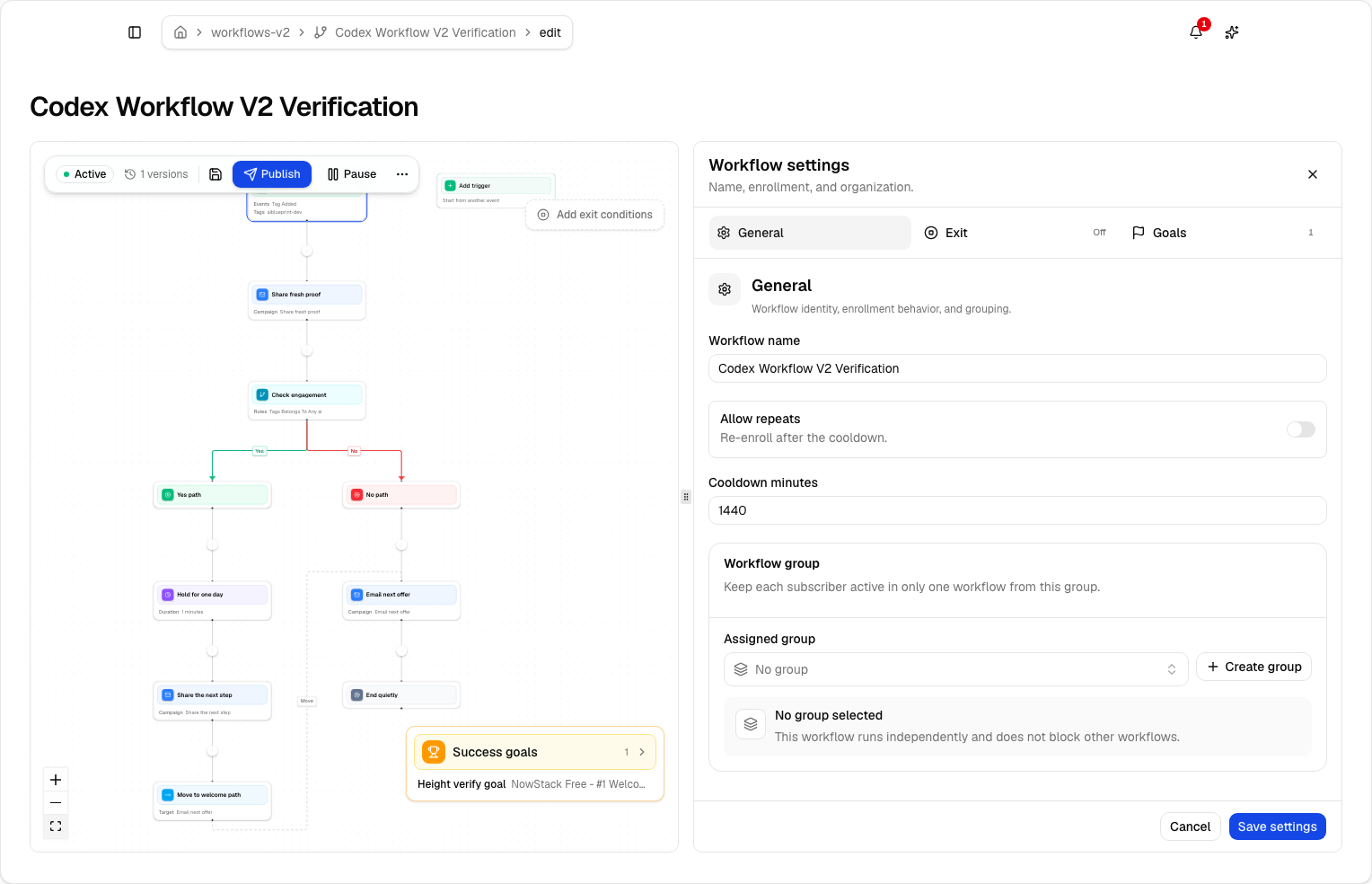
Lumail's workflow engine is graph-based and included on every plan, including Free. It supports subscriber, tag, event, schedule, and manual triggers; email, wait, action, and webhook steps; condition and weighted branches; and goals and exit rules. The same graph is readable and editable from the app, MCP, CLI, SDK, and API.
Both handle transactional email. Customer.io sends it through its API, and those emails count toward your monthly email volume. It does not offer an SMTP relay your app can point at. Lumail sends transactional messages from the same organization through the API or SMTP relay at smtp.lumail.io:587 with STARTTLS, which helps when a framework or legacy system only speaks SMTP.
Migrating from Customer.io to Lumail
Move the email program first and transactional sending last.
- Export people and suppressions. Export people, attributes, and unsubscribes. Import suppressions as well as actives; they protect deliverability and compliance.
- Authenticate your sending domain. Configure SPF and DKIM in Lumail and verify the domain. Keep Customer.io live while DNS propagates.
- Rebuild one journey as a workflow. Recreate your onboarding journey as a graph workflow, send the same events from your app, and test every branch.
- Move transactional email. Switch API calls to the Lumail API or SMTP relay, and confirm delivery for one message type before moving the rest.
- Decide what stays. SMS, push, in-app, WhatsApp, data objects, and reverse ETL have no Lumail equivalent. Keep them on Customer.io or drop them.
Frequently asked questions
Is Lumail a Customer.io alternative?
Yes, for email: campaigns, workflows, transactional sending, and agent access. If your program spans SMS, push, and in-app messages on a customer data platform, Customer.io remains the better fit.
Is Lumail cheaper than Customer.io?
Often, for large lists with moderate sending: 30,000 subscribers mailed weekly is $68 on Lumail and $325 on Essentials. A small user base with heavy lifecycle email can be cheaper on Customer.io.
What is the main difference between Lumail and Customer.io?
Customer.io is a cross-channel engagement platform billed on profiles plus email. Lumail is an email platform billed by volume, with graph workflows, an SMTP relay, and 89 named MCP tools.
Can I migrate from Customer.io to Lumail?
Yes, for email programs. Export people and suppressions, rebuild one journey as a graph workflow, then move transactional email. Prove one of each before cutting over.
Which one should you choose?
Choose Customer.io if you run product lifecycle messaging across email, SMS, push, and in-app, on a customer data platform, and your user base is bounded while your send volume is high.
Choose Lumail if email is the system you operate: agents working through 89 MCP tools, graph workflows on every plan, transactional email through API or SMTP in the same account, and a bill that follows sends rather than stored profiles.
You can start Lumail free with 3,000 emails per month and no credit card, review the pricing plans, or browse the full comparison hub.